It's always good to talk
Candid Response provides a safe, anonymous space for your employees to tell you how they really feel about, well, anything you ask them really.
We set out to break down the communication barriers between employers and employees by making the personal, impersonal.
You only pay for responses, never for questions. There are no setup fees, and no retainer.
Candid Response is a Mind Measure product.
The problem
It's hard to find out what
people really think.
Most people hold back when they sense there could be repercussions. Surveys are often misleading too. We've all ticked "somewhat agree" just to get through the thing. The questions carry little context, and when people know their answers can be traced back to them, there's little honesty in the answers they give.
Candid Response grew out of our work at Mind Measure, where we use AI conversation to help people check in on their wellbeing. We noticed that people were happy to be honest with an AI agent that listened without judgement. We believe anonymous conversational insight can give employers more accurate answers than surveys or one to one interviews ever could. The privacy we built into those wellbeing apps, and carried into Candid Response, is why people feel safe enough to say what they really mean.
See it in action
A conversation not a survey
Respondents follow a link and have a brief conversation on their device. They can see the words on the screen, Allie's questions and their own answers.
Allie sticks to the brief, and asks why, not just what. It's as simple as talking to a friend.
All responses are paraphrased and anonymous, never the respondent's own words.
Pricing
You pay for answers not questions.
We know how irritating opaque pricing can be so we decided to keep it simple.
Buy the credits you need when you need them, one credit per completed conversation for as little as £3. No pushy sales team, no contracts, no onboarding fee. And we will even give you 20 credits free to try it out.
The part no one else does
Your credits never expire
Share the link with your people. Say 100 are invited and 30 take part. You pay for those 30 responses, and that is it. Nothing for the 70 who stayed quiet, and nothing just for asking.
For a small team running their own listening.
- ✓ Anonymous mode
- ✓ Full report and export
- ✓ Run it yourself in minutes
More campaigns, every mode.
- ✓ Everything in self-serve
- ◦ Named private modeComing soon
- ◦ Rehearsal and release modeComing soon
For scale and a branded portal.
- ✓ Everything in growth
- ✓ Branded portal and SSO
- ✓ Priority support
What you get
The result is what's important
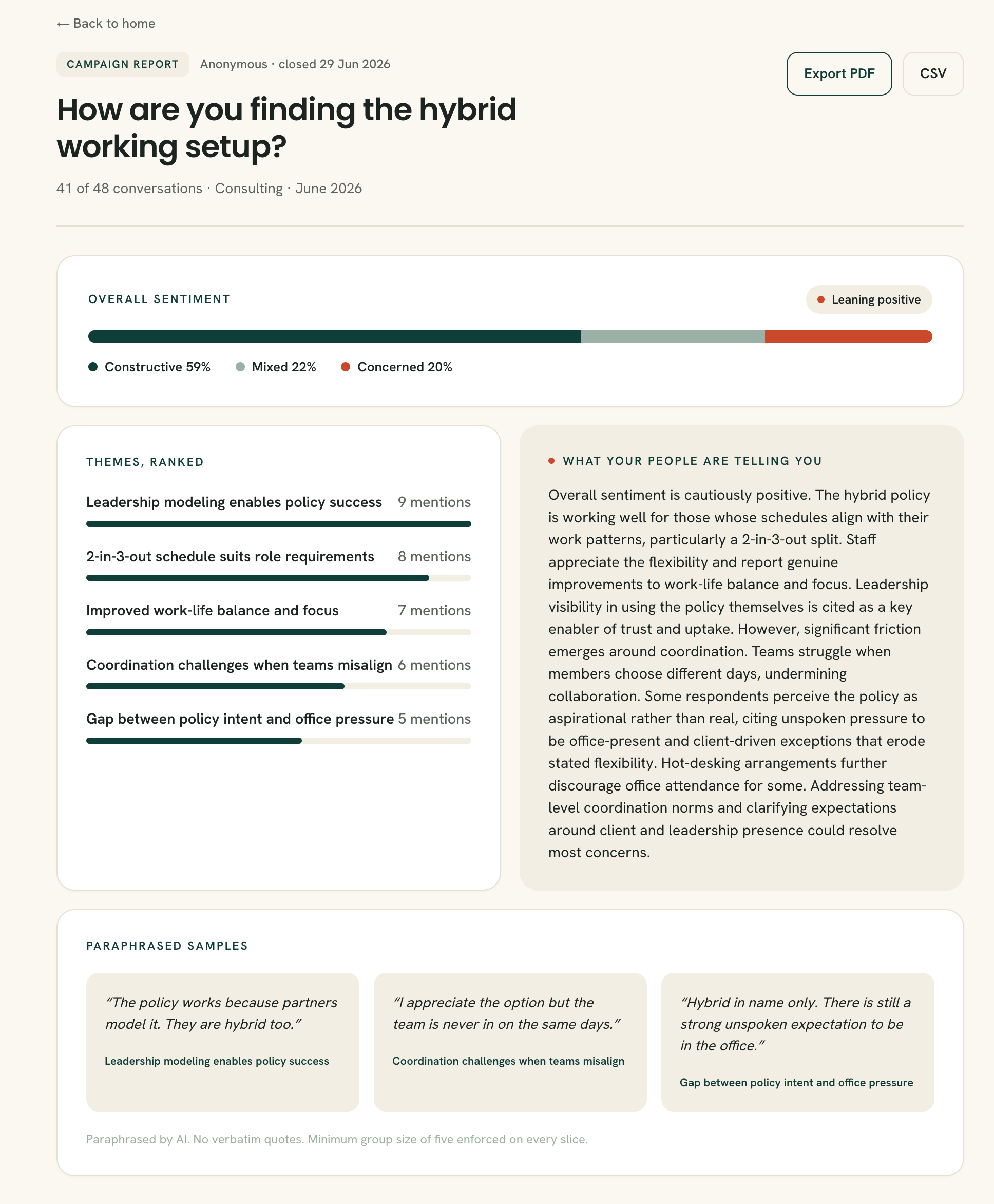
Once your campaign closes, your report is ready in your company dashboard: the themes, the sentiment underlying them, and a handful of paraphrased quotes to give you a flavour of the tone. Ask the same question again later and the report grows a trend line, so you can see whether things actually moved.
Then keep listening
One question is a snapshot.
The loop is the point.
People answer honestly once. They keep answering when they see something happen. So the report is not the end of the story: respond to your team, follow up on the themes that matter, and ask again to watch the trend.
After close, your campaign link becomes a results page for your people: the shared themes plus your published response. Draft it with AI, edit it, publish when you approve.
Re-ask any closed question with one click. Each run joins a series and your report shows sentiment moving run by run.
A theme stands out? Launch a follow-up straight from the report. Allie carries the context into the next conversation.
Restructure, new policy, ways of working, new leadership. Ready-made questions for the moments you need to listen, all editable.
Where it fits
If you want to know,
just ask
At just £3 a response, there are lots of reasons why you might be looking for answers. Whether it's changing patterns of work or taking chips off the menu in the staff canteen, actively listening to your team's views makes people feel heard.
Privacy by architecture
We enforce privacy to enable unvarnished truth.
Could someone be identified by what they said?
The short answer is no.
The longer answer is any speech that has identifying characteristics is stripped out and we have a strict five responses per cohort before we report at all. In addition, you never hear the exact words back. Our process paraphrases the conversations and interprets the underlying sentiment using our unique algorithm.
We keep the AI's paraphrase and throw the word-for-word transcript away once the themes are out.
No name, no email, no token that could ever be traced back to a single response.
We never show a theme, slice or sample that came from fewer than five people.
Anywhere a small group might accidentally give away a headcount, we hold the number back.
Before anyone speaks, a plain-language "what your employer sees" panel spells all of this out. Trust is stated up front, not buried in a policy.





Permission to speak freely.
Ask the questions that matter, and ask them in a way people will actually answer. Start a campaign yourself, or talk it through with us first.